The Story of Maria and Her “Full Coverage” Dream
Maria just bought her dream car, a shiny new electric SUV. She’d worked hard for it, saving up for years, and now it sat gleaming in her driveway in Ventura County. Of course, she got “full coverage” for it. Didn’t everyone? Her lender insisted on it, and frankly, the peace of mind felt good. She figured that meant if anything happened – a fender bender on the 101, a rogue shopping cart at the mall, or even a wildfire incident – she was totally covered. No worries, right?
The short answer is yes. The real answer is more complicated. Maria, like many Californians, assumed “full coverage” was a single, all-encompassing policy. A magic shield. But here’s the thing: it’s not. In the world of California car insurance, “full coverage” is really just a common term for a bundle of different protections. Each piece does a specific job, and understanding them can save you a world of trouble – and potentially, a lot of money.
What “Full Coverage” Really Means in California
“Full coverage” isn’t an actual type of policy you can buy. You won’t find it listed as an option when you’re getting a quote. Instead, it’s a popular way to describe a policy that includes the three big players: liability, collision, and comprehensive insurance. Most people add a few other important protections to that list, especially here in California. Let’s break down what each of these does.

Liability: Protecting Others
Imagine you’re driving down the Pacific Coast Highway, enjoying the view, and suddenly, you’re involved in an accident. If it’s your fault, liability insurance is what kicks in. It’s the most basic type of coverage and it’s mandatory in California. But it doesn’t pay for your car or your injuries. It’s all about the other guy.
Specifically, liability splits into two parts:
- Bodily Injury (BI) Liability: This pays for the medical expenses, lost wages, and pain and suffering of anyone you injure in an at-fault accident. California’s minimums are surprisingly low: $15,000 for injury or death to one person, and $30,000 for injury or death to more than one person. Think about that for a second. An ambulance ride alone can blow past $15,000. A broken bone? Easily more. If you cause a serious accident in a busy spot like downtown Los Angeles, those minimums won’t even scratch the surface of the medical bills. You’d be on the hook for the rest, personally.
- Property Damage (PD) Liability: This covers damage to other people’s property – usually their car, but it could also be a fence, a building, or even a lamppost. The California minimum is $5,000. Five thousand dollars. That might cover a bumper replacement on an older car. But if you rear-end a brand-new Mercedes in Beverly Hills, that $5,000 will vanish faster than a free parking spot on a Saturday.
Seriously, those minimums are a recipe for financial disaster. Any experienced agent, like Karl Susman, will tell you that bumping up your liability limits is often the smartest, most affordable way to protect your assets. We’re talking 100/300/100 or even 250/500/100 limits. It’s a small premium increase for huge peace of mind.
Collision: Fixing Your Own Car After a Crash
This is where Maria’s new SUV comes into play. Collision coverage pays to repair or replace your own vehicle if it’s damaged in an accident, regardless of who caused it. So, if you hit a tree, another car, or even flip your car over (heaven forbid), collision takes care of your ride.
You’ll choose a deductible for collision coverage – often $500 or $1,000. That’s the amount you pay out of pocket before your insurance company starts paying. Higher deductibles mean lower premiums, but you’ll pay more up front if you have a claim. Many people choose a $1,000 deductible to keep their monthly costs down.
When does collision make sense? Almost always if you have a new car, a financed car, or simply want to protect a significant investment. If your car is older, say a 2005 sedan with a market value of $2,000, and your deductible is $1,000, then paying for collision might not be the best use of your money. It’s a calculation of risk versus reward.
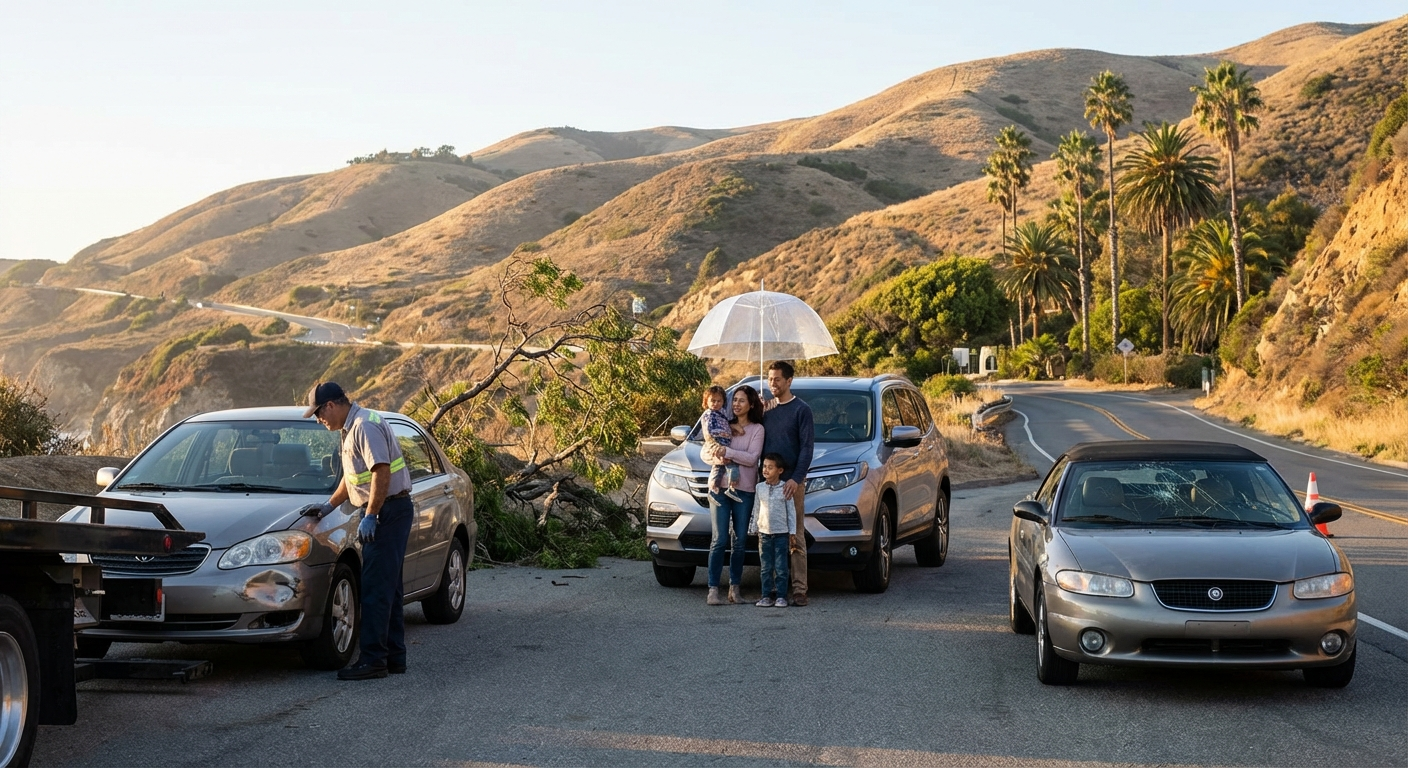
Comprehensive: For Everything Else (But Not Everything)
This is the “non-collision” damage coverage for your car. Comprehensive protects your vehicle from things like:
- Theft or vandalism (a huge concern in some parts of California).
- Fire (especially relevant with California’s wildfire season – think the 2025 LA fires).
- Falling objects (a tree branch in a storm, a rock from a passing truck).
- Natural disasters (hail, floods, earthquakes – though earthquake damage to vehicles is often excluded or has a very high deductible, so check your policy).
- Hitting an animal (deer in the foothills, stray dogs in rural parts of the Inland Empire).
Just like collision, comprehensive comes with a deductible. Often, people choose a lower comprehensive deductible, like $100 or $250, because these claims tend to be less frequent and less severe than collision claims. It’s pretty common for people to have a $500 or $1,000 collision deductible and a $100 or $250 comprehensive deductible.
But wait — comprehensive doesn’t cover everything. It won’t pay for mechanical breakdowns, wear and tear, or items stolen from your car (that’s usually covered by your homeowner’s or renter’s insurance, if you have it).
Beyond the Big Three: Other Important California Coverages
While liability, collision, and comprehensive form the core of “full coverage,” a truly smart California driver adds a few more pieces to their policy. Especially because our state has such unique challenges.
Uninsured/Underinsured Motorist (UM/UIM): Your California Lifeline
This coverage is absolutely essential in California. Why? Because we have a lot of uninsured drivers. Some estimates put the number at around 15% or higher. That’s one in every six or seven cars you see on the road. If Maria, in her new SUV, gets hit by an uninsured driver and they’re at fault, who pays for her medical bills and her car’s damage?
UM/UIM steps in. It covers your medical expenses, lost wages, and pain and suffering if an uninsured or underinsured driver hits you. It also covers damage to your vehicle (UMPD, Uninsured Motorist Property Damage) if the at-fault driver has no insurance. It’s like having insurance for when the other guy doesn’t have enough – or any – insurance. Don’t skip this one. It’s a lifesaver.
Medical Payments (MedPay): For Your Own Injuries
MedPay covers medical expenses for you and your passengers, regardless of who caused the accident. This is different from Bodily Injury Liability, which only covers *other people’s* injuries. MedPay is a quick way to get smaller medical bills paid without waiting for fault to be determined. It’s great for covering deductibles or co-pays on your health insurance, or if you don’t have health insurance. Limits usually range from $1,000 to $10,000.
Rental Car Reimbursement
If your car is in the shop after a covered accident or theft, this coverage pays for a rental car so you’re not stranded. Daily limits and total claim limits apply, like $30/day up to $900 total. If you rely on your car for work or family, this can be incredibly handy.
Roadside Assistance
Flat tire? Dead battery? Locked your keys in your car at a gas station off I-5 near the Grapevine? Roadside assistance can be added for a small annual fee and covers things like towing, jump-starts, fuel delivery, and lockout services. It’s cheap, and when you need it, you *really* need it.
The California Jiggle: What Makes Your Rates Go Up and Down
California car insurance rates aren’t static. They’re a living, breathing thing, always adjusting based on a mix of factors – some you control, some you don’t. Premiums jumped 40% between 2022 and 2024 for many drivers, reflecting a challenging market.
- Your Driving Record: This is probably the biggest factor. A speeding ticket in the Valley or an at-fault accident will definitely send your rates climbing. A clean record keeps them low.
- Where You Live: Insurers look at local claim rates. Someone living in a high-crime area of Oakland or a traffic-heavy zone of downtown San Diego will generally pay more than someone in a quieter, less congested part of Santa Barbara or a rural community.
- What You Drive: Maria’s electric SUV might be safer, but repairs can be pricey due to specialized parts and labor. A common sedan, easy and cheap to fix, will cost less to insure. High-performance or luxury cars? Expect higher premiums.
- How Many Miles You Drive: Commuting from the Inland Empire to Orange County five days a week means more time on the road, more risk. Lower mileage generally translates to lower rates.
- Age and Experience: Young, inexperienced drivers almost always pay more. As you get older and gain a clean driving history, your rates tend to decrease.
- The Insurance Market Itself: This is a big one right now. Between increased repair costs, more severe accidents, and a rise in claims, several big insurers like State Farm, Farmers, and AAA have adjusted their offerings or significantly raised rates in California. It’s a tough market for insurers, which means it’s a tough market for policyholders, too.
California’s Proposition 103 limits what factors insurers can use to determine rates, focusing heavily on driving record, miles driven, and years of experience. This is a good thing for consumers, as it aims to make rates fairer. However, even with Prop 103, external market forces still influence overall pricing.
Is “Full Coverage” Always The Right Move?
For Maria and her new SUV, “full coverage” – meaning a policy with high liability, collision, and comprehensive – was absolutely the right move. If you have a car loan or lease, your lender will almost certainly require it. It’s also smart if your car is relatively new, has a high cash value, or if you simply can’t afford to replace it out-of-pocket after an accident.
The short answer is yes. The real answer is more complicated. The main counterargument is cost. If you have an older car, say a 2008 Honda Civic that’s only worth $3,000, and your collision/comprehensive deductibles are $1,000, then you’re paying a significant chunk of your car’s value in premiums each year for those coverages. At some point, it makes more sense to drop collision and comprehensive and put that money into savings. But that’s a calculation only you can make. And it depends on your financial situation. Some people would rather pay the premium for peace of mind, even on an older car.
Ultimately, the goal isn’t just “full coverage.” It’s *adequate* coverage for your specific situation. That means balancing risk, cost, and peace of mind. What’s right for a family in San Jose might be overkill for a retiree in Palm Springs.
Ready to see what adequate coverage looks like for you? Get a personalized California car insurance quote today.
Don’t Just Assume: Talk to a Pro
Maria’s initial assumption about “full coverage” is common. But as you’ve seen, it’s a lot more involved than a simple checkbox. There are so many moving parts, especially in a state like California with its unique risks and regulations.
That’s where an experienced, independent insurance agent like Karl Susman comes in. Karl, with California Driver Insurance, doesn’t just sell you a policy; he helps you understand what you’re buying. He knows the California market inside and out, from the specific risks in different counties to the nuances of Prop 103. His agency, with CA License #OB75129, works with many different carriers, meaning they can shop around to find the best blend of coverage and cost for your specific needs, rather than being tied to just one company’s offerings.
Don’t leave your financial protection to chance or assumptions. A quick conversation can clarify what “full coverage” truly means for you and ensure you’re not overpaying for something you don’t need, or worse, underinsured when it matters most. Give Karl Susman a call at (877) 411-5200. He’s seen it all and can guide you through the complexities with clear, honest advice.
Want to start with an online estimate? Click here to get a California car insurance quote.
Frequently Asked Questions About California Car Insurance
Q: Do I need full coverage if my car is paid off?
A: Not always. If your car is fully paid off, no lender is forcing you to carry collision and comprehensive coverage. However, if your car still has significant value and you wouldn’t be able to easily afford to replace it out-of-pocket after an accident or theft, keeping these coverages is still a very smart financial decision. It’s a risk assessment you have to make.
Q: What’s the difference between comprehensive and collision?
A: Collision covers damage to your car from accidents involving other vehicles or objects (like hitting a tree). Comprehensive covers damage to your car from non-collision events like theft, vandalism, fire, natural disasters, or hitting an animal. They protect against different types of risks.
Q: Does my deductible apply to all claims?
A: Deductibles typically apply to collision and comprehensive claims. Liability claims (damage to other people’s property or injuries to others) do not have a deductible; your insurance company pays those amounts directly, up to your policy limits.
Q: How can I lower my full coverage premium?
A: Several ways! You can increase your deductibles for collision and comprehensive, maintain a clean driving record, take a defensive driving course, ask about discounts (good student, multi-policy, low mileage), or drive a car that’s cheaper to insure. Shopping around with an independent agent can also make a big difference.
Q: What happens if I cause an accident and don’t have enough liability insurance?
A: If your liability limits aren’t high enough to cover the damages and injuries you cause, you’ll be personally responsible for paying the remaining balance out of your own pocket. This could mean selling assets, wage garnishments, or even bankruptcy. This is why having higher liability limits is so important in California.
This article is for informational purposes only and does not constitute financial advice.